 Rocket Typing
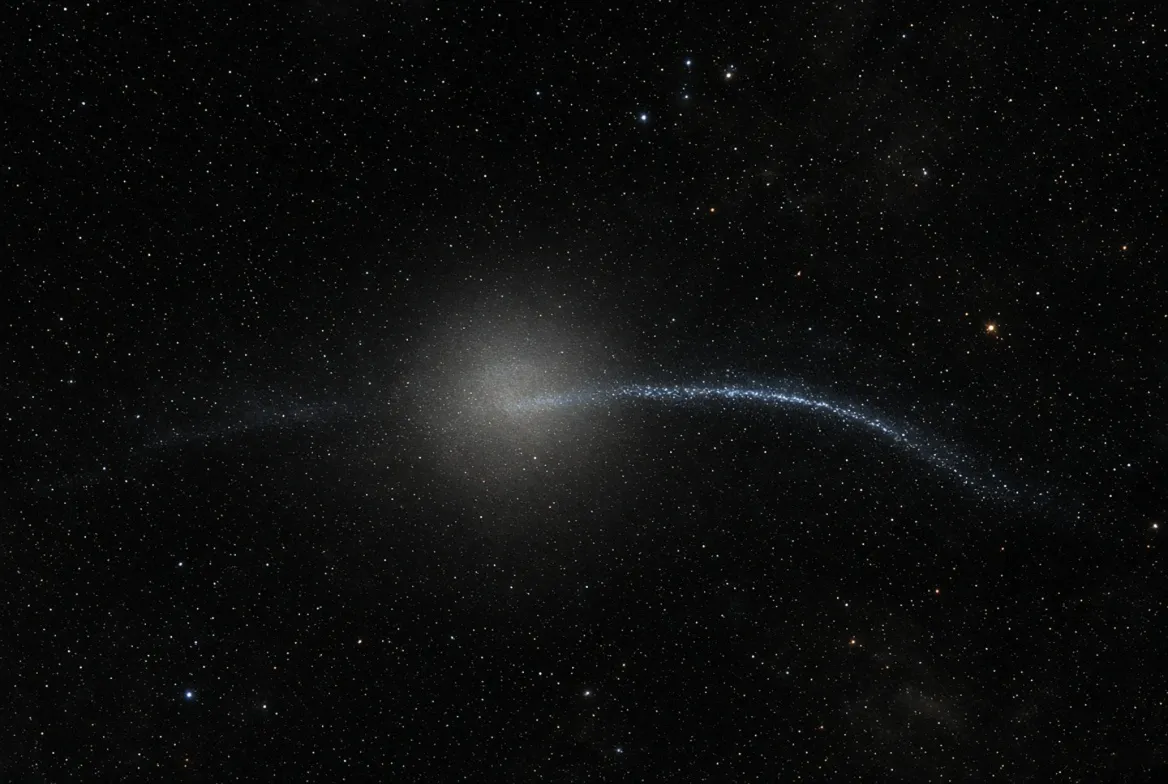
Astronomers have spotted something never seen before outside our own galaxy. They found the first clear stellar stream from a globular cluster in another galaxy. This discovery opens a new window into the invisible dark matter that shapes galaxies across the universe.
What Is a Stellar Stream?
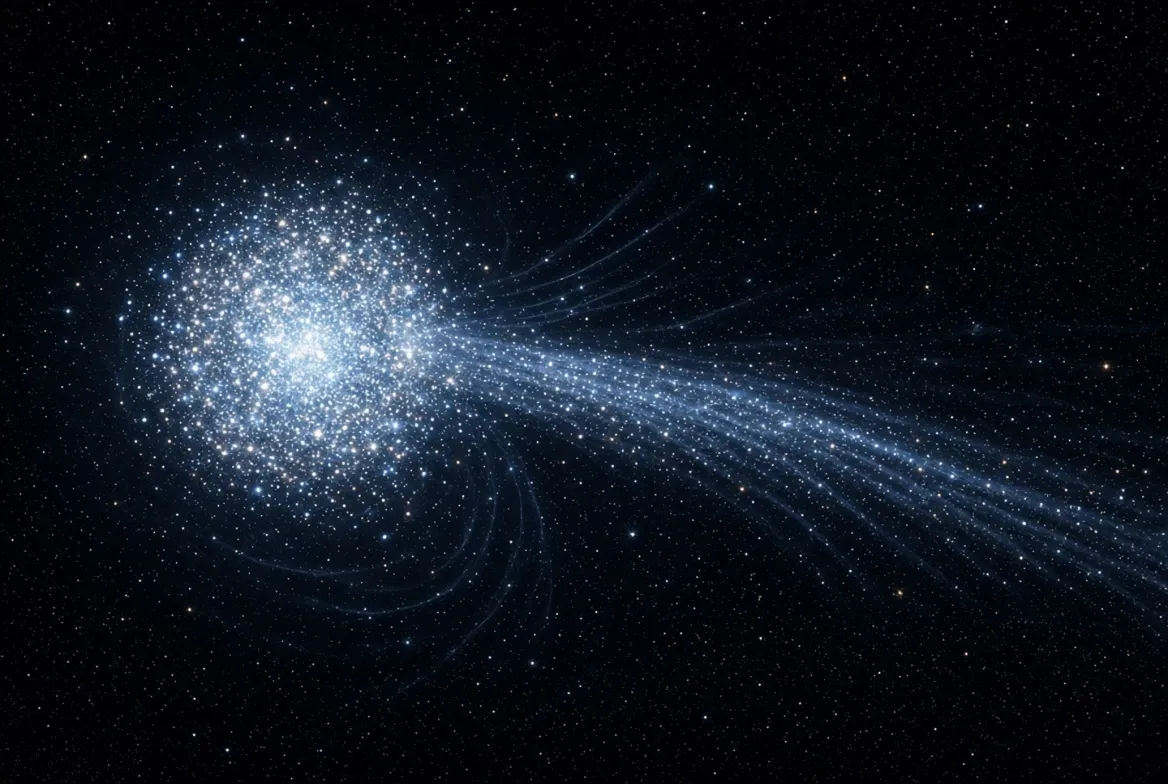
A stellar stream is a long, thin trail of stars. It forms when a dense group of stars, called a globular cluster, gets pulled apart by the gravity of its host galaxy. The stars slowly stretch into a faint ribbon that follows the cluster’s old path. Think of it like a cosmic breadcrumb trail left behind as the cluster slowly dissolves.
Scientists have found many of these streams inside the Milky Way. But they are extremely faint. Until now, no one had clearly seen one from a globular cluster in any other galaxy.
The New Discovery
An international team of researchers made the find. PhD student Julie Kiel Holm from the Niels Bohr Institute and Associate Professor Sarah Pearson from DTU Space led the work. Their results appeared in the journal Nature.
They looked at deep images from the Hubble Space Telescope of a faint galaxy called UGC 9050-Dw1. This galaxy sits about 115 million light-years from Earth. It is an ultra-diffuse galaxy — large in size but very dim because its stars are spread out thinly.
Against this dark background, a narrow arc of stars stood out. The team named the stream Oyashio, after a cold ocean current. The stream connects to a compact object that is likely the remains of the original globular cluster being torn apart.
Independent checks with other telescope data confirmed the feature. Its narrow width and color match what scientists expect from an old globular cluster stream, not from a larger disrupted dwarf galaxy.
Why This Matters for Dark Matter
Dark matter is the invisible material that makes up most of the mass in galaxies. We cannot see it directly, but we feel its gravity. Stellar streams act like tracers. The shape and path of the stream show how gravity pulls on the stars. That gravity comes mostly from the dark matter halo around the galaxy.
For the first time, researchers used a globular cluster stream outside the Milky Way to measure a galaxy’s dark matter. Their models suggest UGC 9050-Dw1 has a massive dark matter halo, as expected for this type of galaxy. The stream gave them new estimates of both the total mass and how the mass is spread out.
This method worked even though the galaxy is very faint. It proves that these streams can serve as useful tools far beyond our own galactic neighborhood.
Looking Ahead
Finding more of these streams will become easier with new telescopes. Future surveys from missions like Euclid and the Nancy Grace Roman Space Telescope should reveal many more. Each new stream will help map dark matter in different kinds of galaxies.
The discovery shows that the same processes we see in the Milky Way also happen in distant galaxies. It gives scientists a practical new way to study the hidden scaffolding of the universe — one faint ribbon of stars at a time.
This simple finding from archival telescope images has opened a fresh path in understanding how galaxies hold together across the cosmos.